

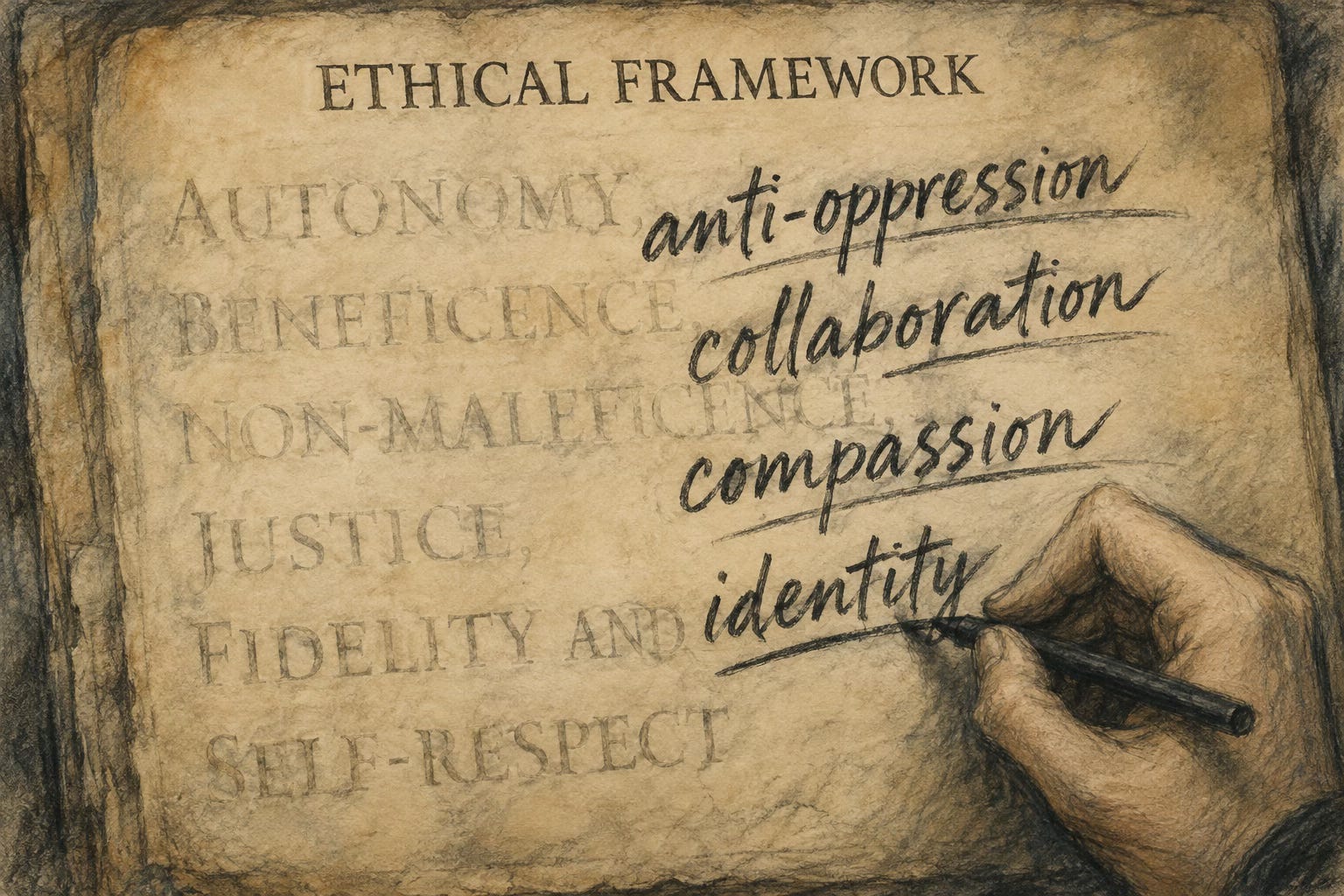
I welcomed, with great enthusiasm, BACP’s 2002 shift from a Code of Practice to an Ethical Framework. I had studied ethics with Professor Tim Bond at Bristol University and appreciated his profound respect for relationships and for both client and practitioner autonomy. Autonomy, beneficence, non-maleficence, justice, fidelity and self-respect were universal enough to unite a diverse profession without requiring adherence to a specific political or theoretical worldview.
This post was inspired by Peter Jenkins’ excellent Critical Therapy Antidote article, ‘BACP Finally ‘Queers’ Its Own Ethical Framework’, which analyses the extent of the changes in BACP’s draft 2025 Ethical Framework. Jenkins highlights several significant departures from the 2018 Framework, including removing clear requirements for evidence-based practice, colleague respect, and acknowledging that children are developmentally distinct from adults. His analysis prompted me to examine the draft psychotherapeutically.
My primary concern is adopting new ‘ethical principles’ that risk shifting our profession from a psychologically to a politicised, identity-informed one.
The draft introduces anti-oppression as an ethical principle, which instructs us to:
‘be aware of relational power dynamics, ensuring relational power imbalances do not create or lead to marginalisation, minoritisation, or “othering”.’
Collaboration is described as ‘a fundamental aspect of ethical practice’ and specifically linked to ‘identity and diversity’ and mitigating ‘potentially harmful power dynamics and inequalities’.
Finally, compassion and kindness must be central to our work.
These concepts appear attractive and benign. After all, what therapist wants to oppress their clients, be uncollaborative or uncompassionate? But attractive principles can contain their own assumptions and shadows. They need scrutiny.
anti-oppression
Therapists must recognise power dynamics. The therapeutic relationship inherently involves an imbalance: they possess clinical knowledge, manage the therapeutic frame, are entrusted with private information and charge for their services.
Power must be exercised responsibly.
But anti-oppression goes further than instructing us not to abuse power. It structures human relationships through concepts of power, identity, marginalisation, minoritisation and othering. These concepts are integral to Critical Social Justice (CSJ), which partly defines social identities by their positions within a power and privilege structures.
Consequently, the therapist may formulate the client socially and politically, instead of letting a psychological understanding emerge from the therapeutic relationship.
‘Anti-oppression’ is therefore not a politically neutral ethical principle. When categorised by privilege and marginalisation, individuals risk becoming secondary to their identity.
Traditional psychotherapists are interested in different things and ask different questions. What happened to you? What meaning did you make of it? What were your early relationships like? We assess relating styles, developmental deficits, trauma symptoms and coping strategies. Social circumstances are relevant, of course, but our focus remains the individual’s unique experience, construction of their world and relationship with us.
Nor should we assume that power flows solely from therapist to client. Therapeutic relationships are psychologically complex and clients can wield considerable interpersonal power. Therapists may feel intimidated, attacked, seduced, idealised, manipulated or frightened. Countertransference can provide insights into an individual that are not discernible from social identity alone.
An ethical framework should require therapists to exercise power responsibly. It should not dictate a specific political theory for understanding power.
collaboration
Collaboration is also appealing; it has a nice ring to it. The draft refers to it as ‘a fundamental aspect of all ethical practice’.
From a CSJ perspective, however, collaboration involves something broader: participation in identifying and dismantling oppression and effecting social change. Then it becomes political activity, not a therapeutically neutral principle.
As a Transactional Analyst, I prefer Adult-to-Adult contracting. It describes two autonomous people entering a shared therapeutic endeavour. The therapist has responsibilities the client lacks. The therapist retains professional authority and responsibility for maintaining the therapeutic frame, upholding boundaries, managing confidentiality, monitoring risk and ethically attending to transference and countertransference. The client retains authority over their own experience.
Adult contracting respects autonomy without feigning equivalence.
A necessary power differential exists, with a corresponding responsibility differential. A CSJ approach confuses authority with authoritarianism, aiming to dispose of it. The therapist’s professional authority exists precisely because they carry professional responsibilities that the client does not.
Flattening that asymmetry risks blurring boundaries rather than improving them.
When collaboration becomes an overriding ethical ideal, it can shift subtly from working with the client towards affirming their existing understanding of themselves. Challenge, curiosity or alternative formulations can then begin to appear ‘uncollaborative’. We can collaborate with a client’s exploration without affirming every conclusion they present with about themselves or the world.
This is important because therapeutic relationships are not always harmonious.
Respectful challenge is crucial to psychotherapy though it can sometimes cause rupture. Clients misunderstand therapists; therapists misunderstand clients. Boundaries may feel like rejection; challenges may provoke anger. Misattunements and disagreements occur. When explored and repaired, rupture can become one of therapy’s most valuable experiences.
Clients and therapists often misunderstand each other. Some clients grew up in families where maintaining relationships required compliance or appeasement; disagreement resulted in rage, punishment, humiliation, withdrawal, or abandonment. Therapy may provide their first experience of genuine conflict resolution: we disagree, something happens between us, and neither of us disappears.
Excessive emphasis on collaboration risks framing rupture as failure. The therapist has responsibilities the client does not, such as boundaries the client may dislike, or challenge. The therapist may relinquish potency, smooth over tension, apologise prematurely, retreat from challenge or become frightened of appearing oppressive or uncollaborative.
A therapist, fearing rupture, may collude.

compassion
The draft requires compassion and kindness at the core of our work. Again, who can argue with that?
Empathy is a more useful therapeutic concept than compassion because they involve different stances towards another person’s distress.
Empathy, as Carl Rogers understood it, means entering and understanding the client’s internal world as if it were one’s own, while retaining the ‘as if’ quality. It prioritises presence and deep understanding without trying to change or remove the experience.
Compassion, additionally incorporates sympathy and the desire to alleviate suffering. That sounds admirable, but it has a shadow.
The urge to relieve distress can shift the therapist into helping, fixing or rescuing. This may lead to premature reassurance, offering solutions, removing appropriate frustration or avoiding difficult material. What relieves suffering immediately does not necessarily facilitate psychological growth.
A strong compassionate impulse can also blur relational boundaries and lead to greater emotional involvement. In Transactional Analysis, we might recognise the Rescuer.
When the therapist’s task becomes ‘taking your suffering away’, the client’s agency can diminish. They risk becoming a recipient of care rather than an active participant discovering their own resources and meanings.
Sometimes the therapist must help a client face painful material rather than soften it. Compassion can make necessary challenge feel ‘unkind’.
We have seen something similar culturally in the injunction to ‘Be kind’. In principle, who could disagree? However, in practice, kindness can become conditional: be kind to those who affirm one’s worldview. Those who question its assumptions may be denied generosity, instead characterised as harmful, bigoted, or unsafe. For those who do not share the CSJ worldview, ‘Be Kind’ can sometimes feel remarkably like “shut up”.
Compassion has another political shadow. An intersectional framework can create an implicit hierarchy of vulnerability and moral concern. Those occupying multiple marginalised identities might assert a stronger claim to protection, validation and compassion. Conversely, those deemed privileged or powerful risk being seen as less vulnerable, or even as the source of others’ oppression.
Compassion then stops flowing simply in response to an individual’s suffering and becomes filtered through their position within a social hierarchy.
This matters greatly in psychotherapy.
A client perceived as privileged may be traumatised, frightened, bereaved, ashamed, or profoundly vulnerable. Alternatively, a perceived victim may behave destructively, wield power, manipulate others or cause harm.
For those of us who do not share the viewpoint, human beings stubbornly refuse to arrange themselves according to theoretical hierarchies.
When compassion is distributed by perceived oppression, it is no longer universal; it risks becoming morally weighted by identity.
Psychotherapy demands more: remain compassionate towards the individual without assessing their place in a hierarchy of privilege and oppression, and without letting compassion interfere with our ability to think, challenge, and see them whole.
sex, gender and identity
Another omission in the draft is particularly interesting. In its discussion of ethical decision-making, BACP asks practitioners to consider characteristics of the people involved, citing ‘age, culture, gender, disability, or any other identity characteristic’. Sex is absent.
Later, the Framework generally refers to protected characteristics under the Equality Act 2010, which necessarily includes sex. Why foreground ‘gender’ and broader ‘identity’ characteristics, but omit sex?
Sex is a protected characteristic under the Equality Act; gender is not, while gender reassignment is separately protected. The omission is particularly notable following the Supreme Court’s 2025 For Women Scotland judgment, which confirmed that ‘sex’, ‘woman’ and ‘man’ in the Equality Act refer to biological sex.
At the very least, in an Ethical Framework produced following such a significant clarification of equality law, omitting sex while explicitly naming gender warrants an explanation.
It reinforces my concern that identity, not psychology, is increasingly becoming the primary lens through which the client is viewed.
The shift becomes still more striking when we consider what has been lost.
Jenkins notes the 2018 Framework valued ‘research and systematic inquiry’ to enhance professional knowledge and ‘provide an evidence base for practice’. The draft instead requires practitioners to keep their skills and knowledge up to date.
These are not equivalent. A belief can be fashionable and up to date without being supported by good evidence.
The 2018 Framework also required therapists working with young people to possess knowledge and skills appropriate to their development. As Jenkins observes, that explicit developmental prerequisite has ceased to be a feature.
Children and young people remain explicitly recognised as a safeguarding category, but the positive requirement to understand them as a developmentally distinct therapeutic population has gone. Where is the psychologically meaningful distinction between child and adult?
The 2018 Framework explicitly expected colleagues to be treated respectfully. Although respectful communication remains in the draft, the previous ethical architecture around collegial respect has diminished. Given the unusually fierce disagreement within our profession, that seems an unfortunate direction of travel.
Finally, the new Framework carries a vacuous strapline, ‘Working ethically is working within relationships.’ I find this strange and meaningless. It tells us nothing about what distinguishes an ethical relationship from an unethical one.
Both ethical and unethical therapists work within relationships. Boundary violations, dependency, exploitation and collusion all occur within relationships.
conclusion
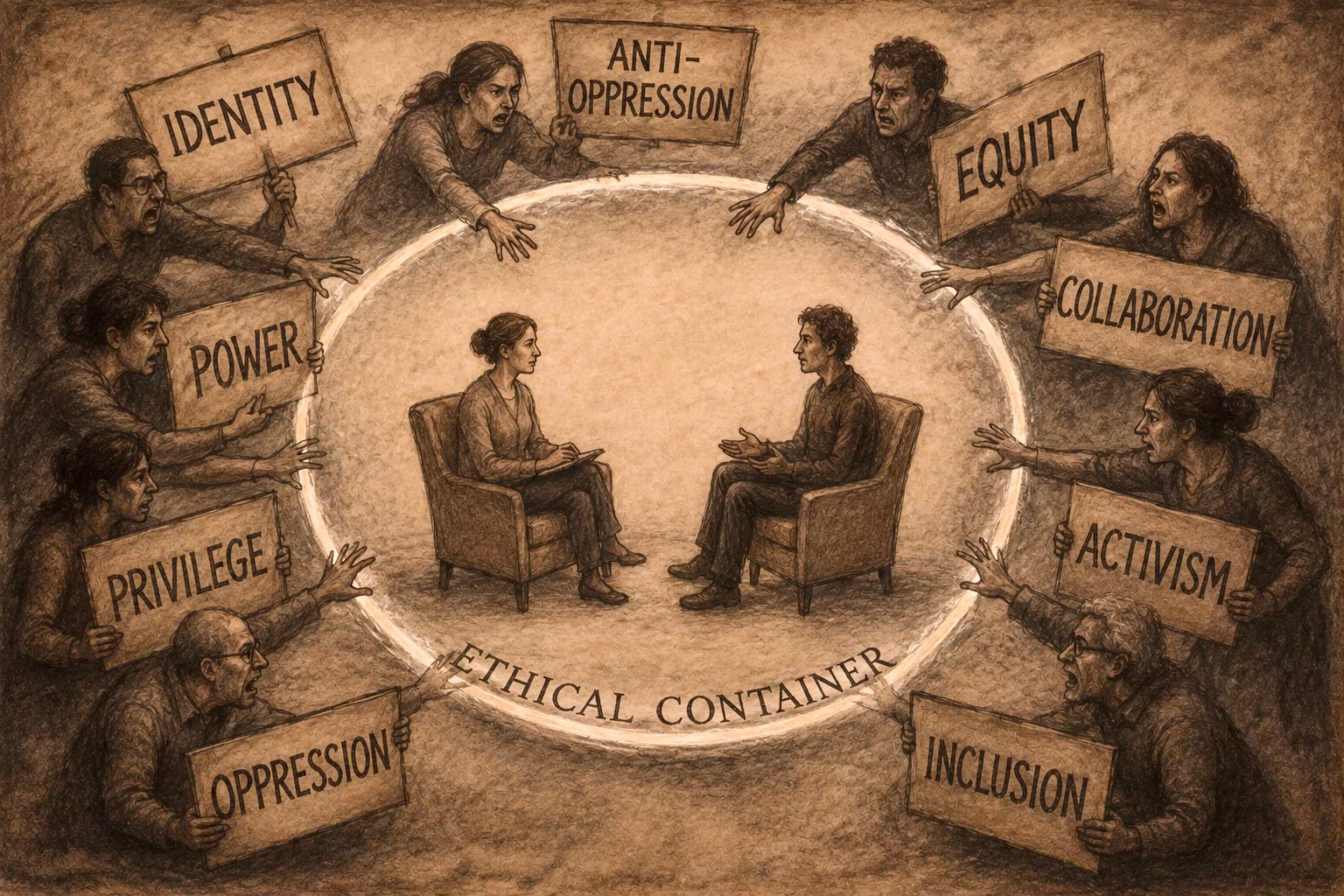
An Ethical Framework should provide a broad ethical container for various therapeutic traditions and philosophies to flourish. It should not prescribe a particular social or political understanding of the person.
Human beings are extraordinarily complex.
BACP’s proposed Ethical Framework is becoming psychologically thinner as it becomes politically thicker.
That is not an evolution of psychotherapy.
It is a political revolution within psychotherapy — I am appalled and heartbroken.
Read about support groups for therapists, and an Education Warrior programme for all below.
support groups
Differently Aware Psychological Therapists
a protected space for psychological therapists who hold narratives that differ from the global mono-narratives of the mainstream media (MSM) to share their thoughts and experience (including but not limited to Queer Theory and Gender Identity).
Specifically to challenge the impact of Queer Theory and Gender Identity Ideology on our freedom to practice ordinary exploratory therapy. *including a support group for therapists in training*
a splendid training opportunity
the Education Warrior programme with Barry Wall, EDI Jester
‘Rise above misinformation & woke chaos! For ALL passionate about reality, not just teachers. No experience needed! Start simple, grow at your pace—no stress. Fits busy lives, young or old. Join us and boost your thinking & confidence. The fight for free thought is now’.
I am so glad you are reading this, thank you! Foundation for Academic Integrity and Responsibility is solely reader-supported. Please like, share or become a free or paid subscriber. That is so encouraging! If you can’t or don’t want to be a paid subscriber, please consider, as a one off, much appreciated contribution, buying me a coffee. I love coffee!
I am not a psychotherapist but find your commentaries very interesting and informative, particularly in view of the dominance of genderist ideology apparently in almost all institutions and organisations. I did not imagine that psychotherapy would adopt it because I assumed it to be critically reflective not political. Thank you for publishing.
The sinister invasion of an authoritative political position into the therapeutic relationship completely alters the fundamentals of counselling. This is unethical. It is wrong. The power dynamics in therapy have always been there, as they are in any relationship, especially contracted ones. CSJ is a political belief. It has no place in the therapy room.